
HN
@heloix_news
Tech

How to Launch a NFT Marketplace in Just 3 Days
#NFTMarketplace#NFTs#DigitalAssets
Comment
658
The global property and real estate market has experienced a major digital shift over the past decade. Property buyers, tenants, real estate agents, and property developers no longer rely solely on physical yard signs or traditional print classifieds. Instead, modern property transactions begin on digital real estate marketplaces. For proptech entrepreneurs, startup founders, and software operators, building a multi-vendor real estate listing platform represents one of the most lucrative and high-ticket opportunities in the software ecosystem.
Whether you are seeking to launch real estate marketplace operations in a specific city, looking to acquire real estate platform source code, or evaluating turnkey software frameworks that are ready to launch real estate marketplace white-label platforms into the market, understanding how this business model scales is essential.
Here are the top 5 reasons entrepreneurs are heavily investing in real estate marketplace platform business models today.
Real estate transactions—whether residential sales, commercial leases, or vacation rentals—represent some of the largest financial commitments consumers and businesses make.
By providing a centralized digital portal equipped with interactive map searches, high-resolution photo galleries, virtual 3D tours, and neighborhood analytics, your platform becomes the primary connection point for high-intent buyers and sellers.
High listing volume combined with serious buyer intent gives portal operators strong leverage to monetize every stage of the real estate discovery journey.
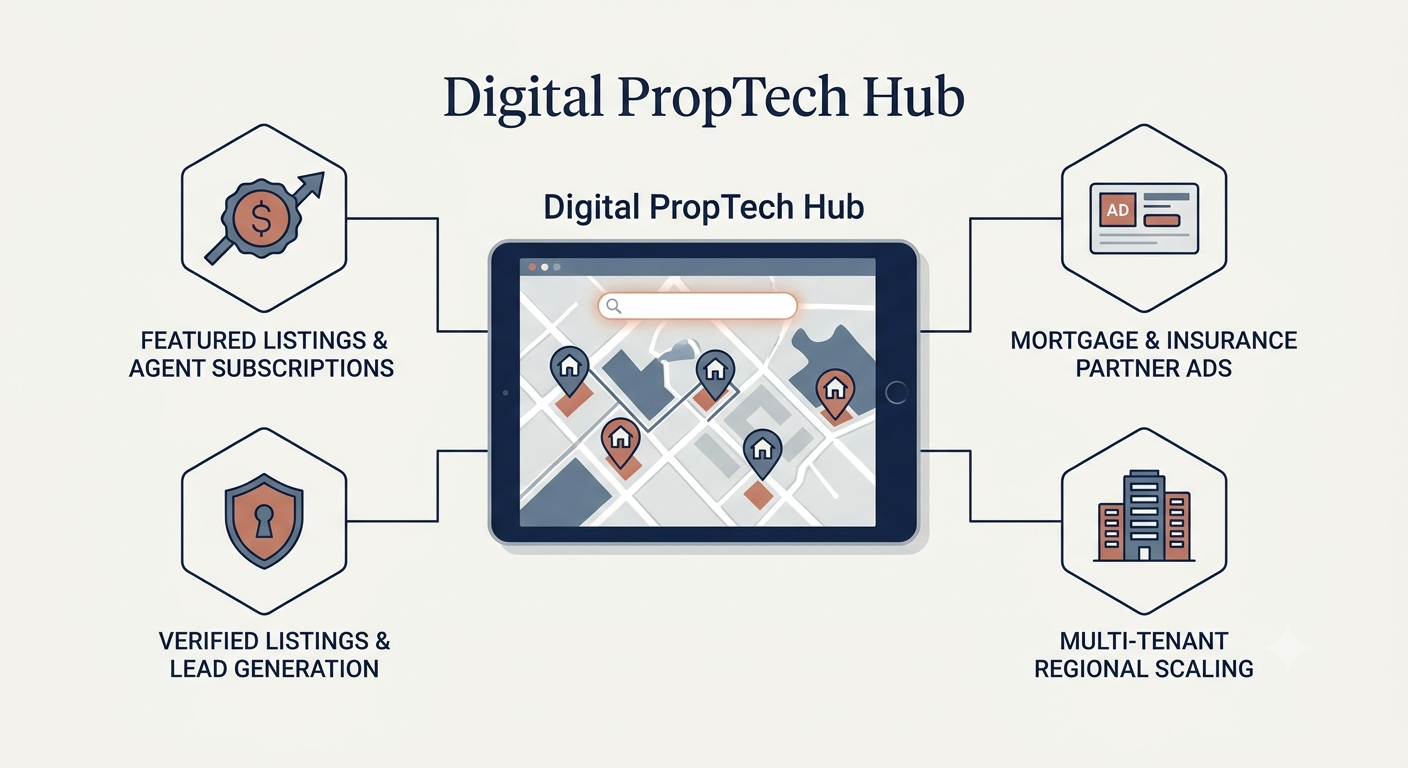
A real estate marketplace acts as a multi-channel revenue generator by collecting fees from various stakeholders across the property ecosystem:
Featured Listing & Visibility Fees: Charging property agents, brokers, and individual sellers premium fees to pin their listings to the top of search results or feature them on the homepage.
Agent Subscription Plans: Offering tiered monthly or annual packages to real estate agents and brokerages for unlimited property postings, lead-capture forms, and dedicated agent profile pages.
Lead Generation & Referral Commissions: Selling verified buyer/renter lead profiles directly to licensed local real estate agents or taking a percentage commission on closed deals.
Banner Ads & Partner Placements: Monetizing high site traffic by hosting targeted advertisements for home loan providers, mortgage brokers, interior designers, moving companies, and property insurance firms.
Building a complex real estate marketplace from scratch—engineering spatial search algorithms, MLS/IDX data integration, multi-vendor agent dashboards, automated lead distribution systems, and mobile apps—traditionally required massive engineering capital and months of custom software development.
This is why many proptech founders choose to leverage pre-built white-label solutions that are ready to launch real estate marketplace platforms out of the box. Utilizing pre-tested, modular software allows operators to bypass complex core development, apply custom branding, configure local payment systems, and launch their property portal in a fraction of the time.
Real estate portals are inherently optimized for dominant search engine indexing:
Every property listing, agent directory, and neighborhood guide creates a new, indexable webpage rich in localized search keywords (e.g., "3 BHK apartments for sale in [City]").
As listing inventory grows, organic search visibility multiplies, creating a compounding traffic loop that drives down customer acquisition costs (CAC) over time.
The white-label agency model allows software operators to expand horizontally across distinct geographic regions or specialized property niches without scaling backend development costs.
Modern real estate platforms feature modular multi-tenant architectures, enabling you to manage distinct sub-portals (e.g., luxury residential sales, commercial office leasing, or short-term vacation rentals) from a single master administrative dashboard.
Each regional sub-hub operates with customized property attributes, local currency settings, localized agent commission rules, and independent brand identity.
Please to post a comment
No comments yet
Be the first to share your thoughts.
@heloix_news
Tech
@heloix_news
Tech

@heloix_news
Tech

Subscribe for the latest on technology, business growth and digital transformation.