
HN
@heloix_news
Policy
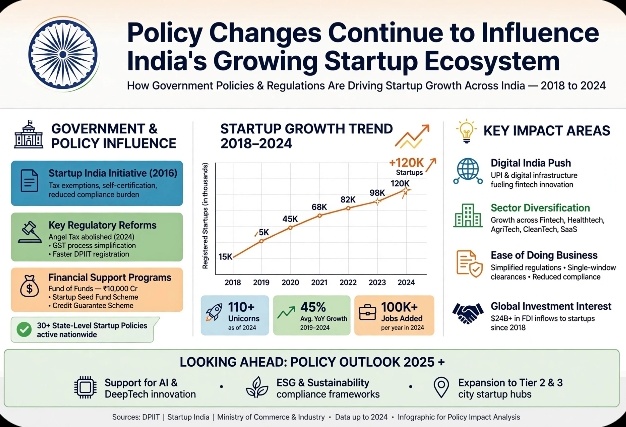
Policy Changes Continue to Influence India’s Growing Startup Ecosystem
#Policy#StartupIndia#Business#Government#Entrepreneurs
评论
1.5K
Shreya
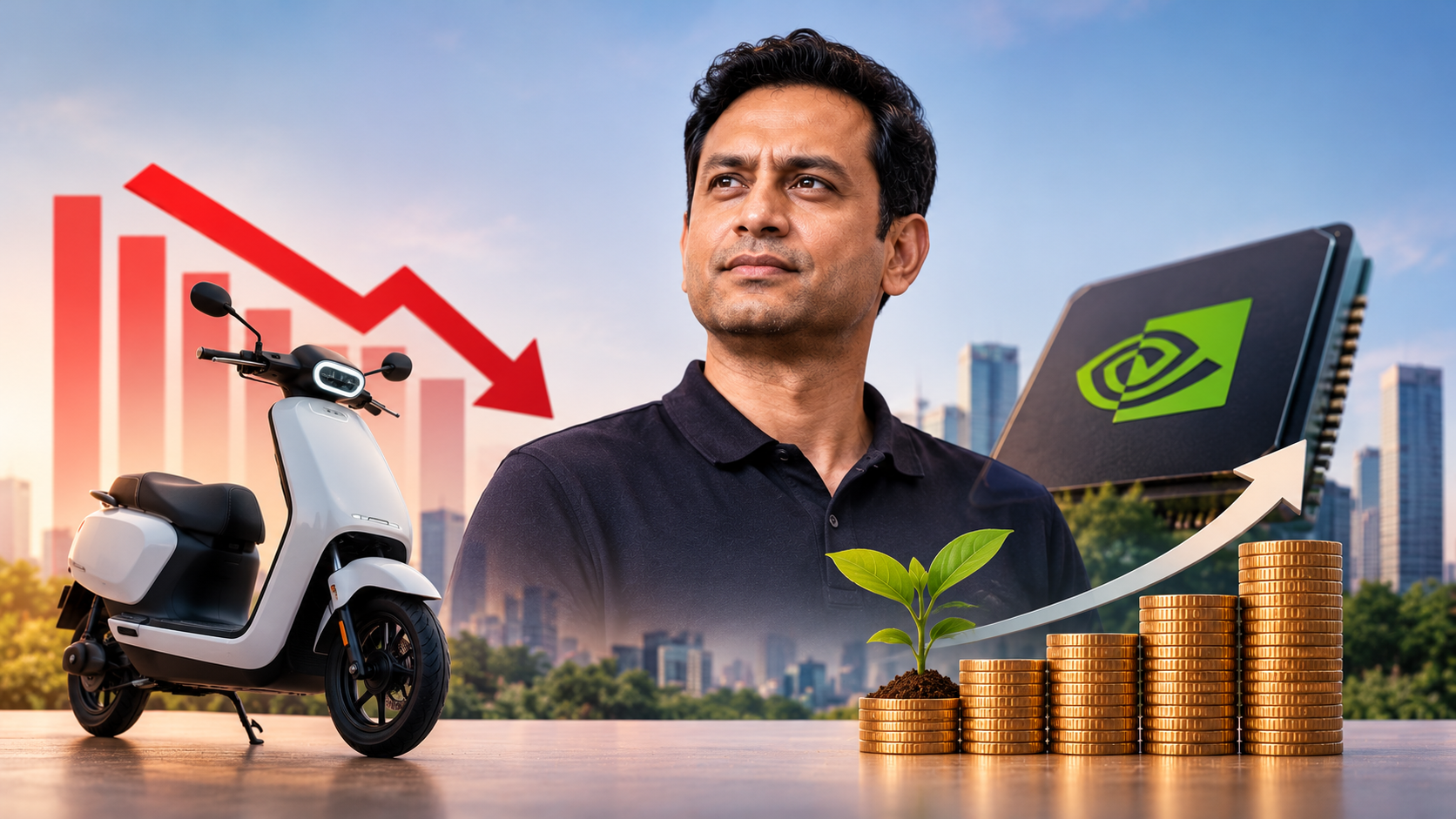
Ola Electric reported another challenging quarter, with revenue declining sharply amid supply chain constraints and weaker vehicle sales. Although the electric two-wheeler maker managed to reduce its year-on-year net loss, its cash flows and operating performance remain under pressure.
Meanwhile, the latest startup and technology developments include a reported leadership change at NVIDIA, a potential $32 Mn fundraise by online pharmacy PlatinumRx, OpenAI’s expansion of its India operations, a proposed UPI incentive scheme and Turtlemint’s mixed Q2 performance.
Here is a closer look at the key developments.
## Ola Electric’s Q2 Revenue Drops 39%
Ola Electric’s Q2 FY27 results highlighted the challenges facing its business. Operating revenue fell 39% year-on-year (YoY) to ₹421 Cr from ₹690 Cr in the corresponding quarter last year.
The company’s consolidated net loss narrowed 13% YoY to ₹362 Cr, compared with ₹418 Cr in Q2 FY26. However, the loss widened 8% sequentially from ₹336 Cr in Q1 FY27.
Total income declined 41% YoY to ₹448 Cr, while total expenses fell 28% to ₹639 Cr. Despite the reduction in expenses, operating EBITDA loss increased 7% YoY to ₹218 Cr. Gross margin also weakened to 29.9%, down from 30.9% a year earlier.
Supply chain constraints, particularly shortages of components and chargers, affected vehicle production and deliveries. The company said its immediate priority is to improve supply availability and scale production. It expects output to reach around 25,000 vehicles in December.
### Ola Electric Moves Towards a Dealer-Led Model
Ola Electric is also restructuring its distribution network to reduce costs and improve working capital efficiency.
After announcing the shift to a dealer-led model in August, the company began opening dealer-operated outlets in September. By November 8, it had onboarded 255 dealer partners and established more than 300 stores.
The company is targeting 450 stores by December 2026 and 700 by March 2027. It stopped accepting orders through its direct-to-consumer stores from November 1, with most company-owned outlets expected to shut by December.
Under the revised model, dealers will purchase vehicles from Ola Electric and manage inventory at their own outlets. This is expected to reduce the company's spending on retail operations and inventory financing.
Ola Electric expects the transition to lower operating expenses by around ₹50 Cr. However, dealer commissions could put pressure on gross margins in the near term. The company expects this impact to ease as its dealer network stabilises over the next two to three quarters.
### Supply Chain and Cash Flow Remain Key Challenges
Ola Electric has said that demand is no longer its biggest constraint. Instead, the company needs to scale its supply chain to support higher production.
It expects to benefit from vertical integration, in-house engineering and a more integrated component architecture. Founder and Chairman Bhavish Aggarwal also said the company's bill of materials costs are 15–20% lower than those of competitors, although this is a management claim.
The company continues to report negative cash flows. Its operating cash flow stood at negative ₹188 Cr, while free cash flow was negative ₹371 Cr during Q2 FY27.
To strengthen its balance sheet, Ola Electric raised ₹780 Cr through a qualified institutional placement in June and another ₹1,000 Cr through a rights issue that concluded recently.
Its total borrowings declined to ₹1,819 Cr in September 2026 from ₹3,132 Cr in December 2024. Borrowings in the automotive business fell to ₹337 Cr from ₹2,422 Cr over the same period.
The company also expects changes to the GST refund mechanism, effective November 1, 2026, to shorten refund timelines and ease working capital requirements.
### Gigafactory and Cell Manufacturing Plans
Ola Electric is working to improve production yields at its Gigafactory as it expands its in-house battery cell operations.
The company said it achieved the scheduled commercial operation date for its 6 GWh cell manufacturing capacity ahead of schedule. It is now focused on improving production efficiency and reducing manufacturing costs.
NMC cell yields were in the mid-70% range, with the company targeting 80–85% over the next few months and eventually 90%.
It is also scaling up lithium iron phosphate (LFP) cell production and expects yields to reach around 70% by the end of Q4 FY27. The company plans to begin integrating its in-house LFP cells into vehicles towards the end of Q4 FY27 or early Q1 FY28.
Ola Electric intends to stabilise its existing 6 GWh capacity before expanding it to 20 GWh. It is also exploring opportunities to supply cells to other vehicle manufacturers and serve the energy storage market.
The company's next phase of growth will depend on improving production, increasing cell manufacturing yields and turning its investments into stronger cash flows.
Ola Electric shares ended the trading session 3.7% higher at ₹35.73 apiece on the BSE.
## NVIDIA CEO Jensen Huang Reportedly Steps Down
The roundup also reports a major leadership development at US-based chipmaker NVIDIA, claiming that co-founder Jensen Huang has stepped down as CEO after 33 years at the helm.
According to the report, the company's board announced that Huang had resigned from his positions as president, CEO and board member with immediate effect. CFO Colette Kress was named interim CEO while the board searches for a successor.
The report also links the development to allegations concerning Huang's personal relationships, including a claim involving a woman accused of spying for China. These are serious claims and should be treated as allegations; the source material does not independently establish them.
## PlatinumRx Reportedly Eyes $32 Mn Fundraise
Bengaluru-based online pharmacy startup PlatinumRx is reportedly in talks to raise more than ₹300 Cr, or around $32 Mn, in a new funding round.
Belgium-based investment firm Sofina Ventures is expected to lead the proposed round. The transaction could value the startup at approximately $150 Mn–$200 Mn.
Founded in 2023, PlatinumRx operates an online pharmacy focused on providing affordable alternatives to prescribed medicines. The company claims to have served more than 10 lakh users so far.
It previously raised $6 Mn in its Series A round last year.
The potential fundraise comes amid investor interest in specialised healthcare platforms, particularly businesses focused on medicine affordability, product availability and convenient digital access.
## OpenAI Expands Its India Operations
OpenAI has introduced local inference and data processing for its APIs in India, allowing API requests and model computations to be handled within the country.
According to the report, the service is initially available for the GPT-6 Luna model. The move could help OpenAI address enterprise demand for local data processing and residency requirements.
With India joining Australia and Japan, the country becomes the third market where OpenAI has introduced API inference residency.
Separately, the company has launched a beta feature that allows businesses to claim and manage their profiles on ChatGPT. Merchants can also add product feeds and access insights into how users discover and interact with their businesses through the platform.
## NPCI Introduces New UPI Incentive Scheme
The National Payments Corporation of India (NPCI) has introduced the UPI Vyapaar Saksham Scheme to encourage banks and merchants to expand the deployment of QR codes and soundboxes.
The proposed scheme will use a portion of the merchant discount rate earned by banks and other UPI ecosystem participants to fund incentives. It is expected to run for three years from the implementation of UPI MDR, which has not yet been notified.
Under the scheme, acquiring banks will receive:
- ₹300 for every QR code deployed at an eligible new small merchant.
- ₹750 for every soundbox deployed at an eligible new small merchant.
Financial institutions will also receive incentives for increasing UPI transaction volumes among both new and existing merchant groups.
The initiative aims to encourage wider merchant adoption and support further growth in digital payments.
## Turtlemint Narrows Q2 Loss by 67%
Insurtech company Turtlemint reported a mixed performance in Q2 FY27, with a sharp reduction in losses alongside continued revenue growth.
The company's net loss fell 67% YoY to ₹25.8 Cr, while operating revenue increased 35% to ₹342.2 Cr.
However, expenses rose 25% YoY to ₹375.2 Cr during the quarter.
On the business front, platform premiums grew 55% YoY to ₹1,214 Cr. Turtlemint also said it added 69,000 new digital partners during the first half of FY27.
The company is monitoring the Insurance Regulatory and Development Authority of India's (IRDAI) draft framework proposing lower commissions for insurance agents. It has not shared its FY28 stress-case projections and said it would provide more clarity once the final regulations are released.
Turtlemint expects its service EBITDA to remain broadly stable in absolute terms next year.
## Startup Spotlight: Maasi Wants to Organise the Nanny Hiring Market
Finding a reliable nanny remains a challenge for many working parents, who often depend on personal referrals and informal WhatsApp groups. This can make it difficult to assess a caregiver's training, experience and availability.
Founded in 2025, Maasi is attempting to bring more structure to the childcare market by connecting families with verified and trained caregivers.
The platform offers on-demand nanny services starting at ₹199 per hour, along with monthly subscriptions beginning at ₹5,999.
### Screening and Training Caregivers
Maasi says every caregiver joining its network undergoes a 16-point psychometric assessment and a free training programme developed with inputs from preschool directors and nurses.
The startup also offers English-speaking governesses trained in screen-free childcare activities.
### Early Traction and Expansion Plans
Maasi claims to have served more than 1,200 parents through a network of over 500 caregivers.
Its public launch in October 2026 reportedly generated a waitlist of more than 4,000 parents within five days.
The company plans to focus on expanding its caregiver network, improving its technology platform and growing its presence in Bengaluru.
Its biggest challenge will be maintaining consistent service quality and building trust as it expands its supply of caregivers.
For Maasi, long-term growth will depend on whether it can make organised, reliable childcare accessible without compromising the quality of care.
请先 以发表评论
暂无评论
成为第一个发表评论的人。
@heloix_news
Policy
@heloix_news
Policy
@heloix_news
Policy

订阅以获取前沿技术、业务增长与数字化转型的最新资讯。