
HN
@heloix_news
EdTech
Top 5 Reasons Entrepreneurs Are Investing in School Management Software
#Edtech#school#technology
Comment
527
Mahesh P

Teaching students is only one aspect of running a school. Schools need to manage admissions, attendance, fee collection, examinations, parent communication, and countless administrative tasks. As more educational institutions look for ways to simplify these responsibilities, school management software has become an attractive business opportunity for entrepreneurs.
For aspiring business owners, this creates an interesting possibility: instead of building a software product from scratch, they can offer digital solutions that schools already need.
But what does success in this business actually look like? And how can someone enter the education technology market without spending years developing software?
Let's examine the prospects, real-world business examples, and actions entrepreneurs may take to create a school management software company.
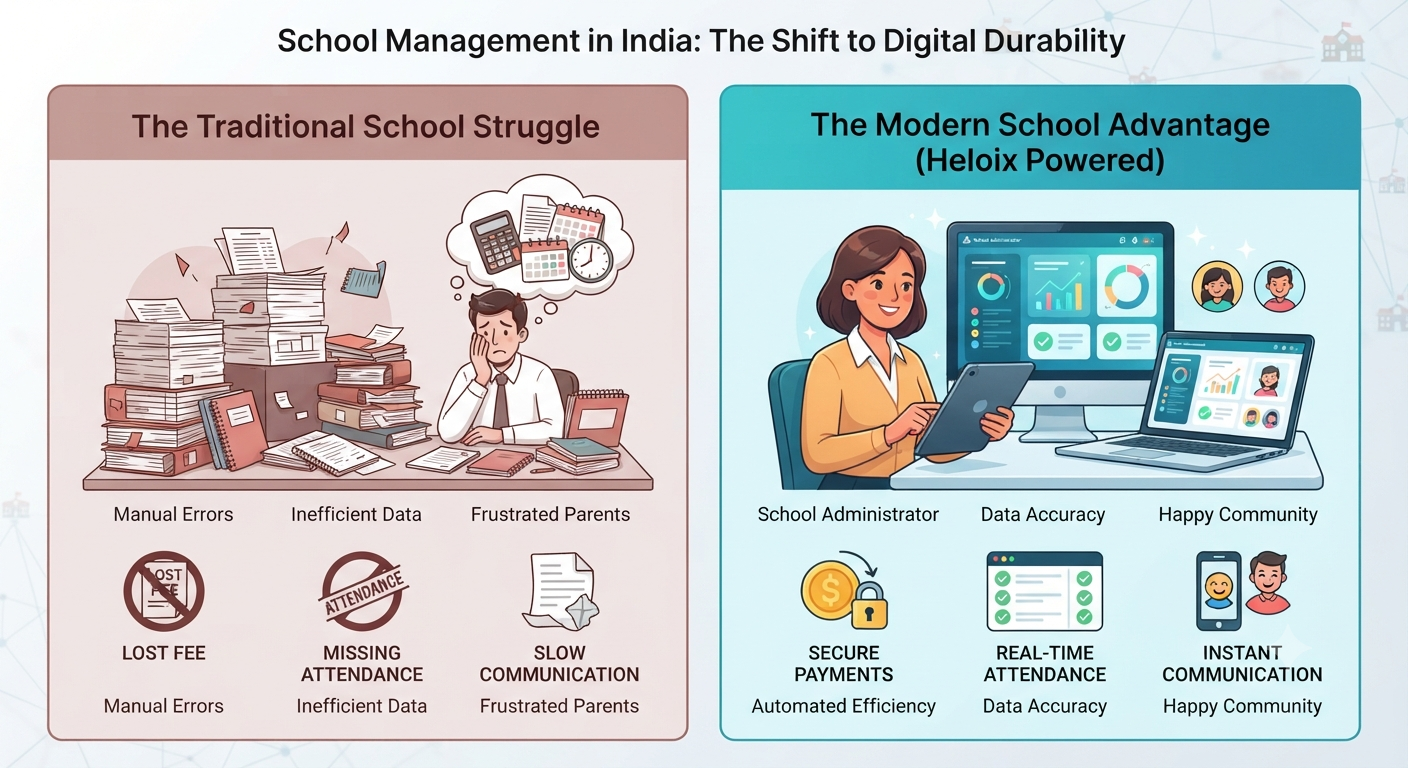
Consider a school that still uses registers to track attendance, collects fees by hand, and makes one-on-one phone calls to parents. These processes consume time and increase the chances of errors.
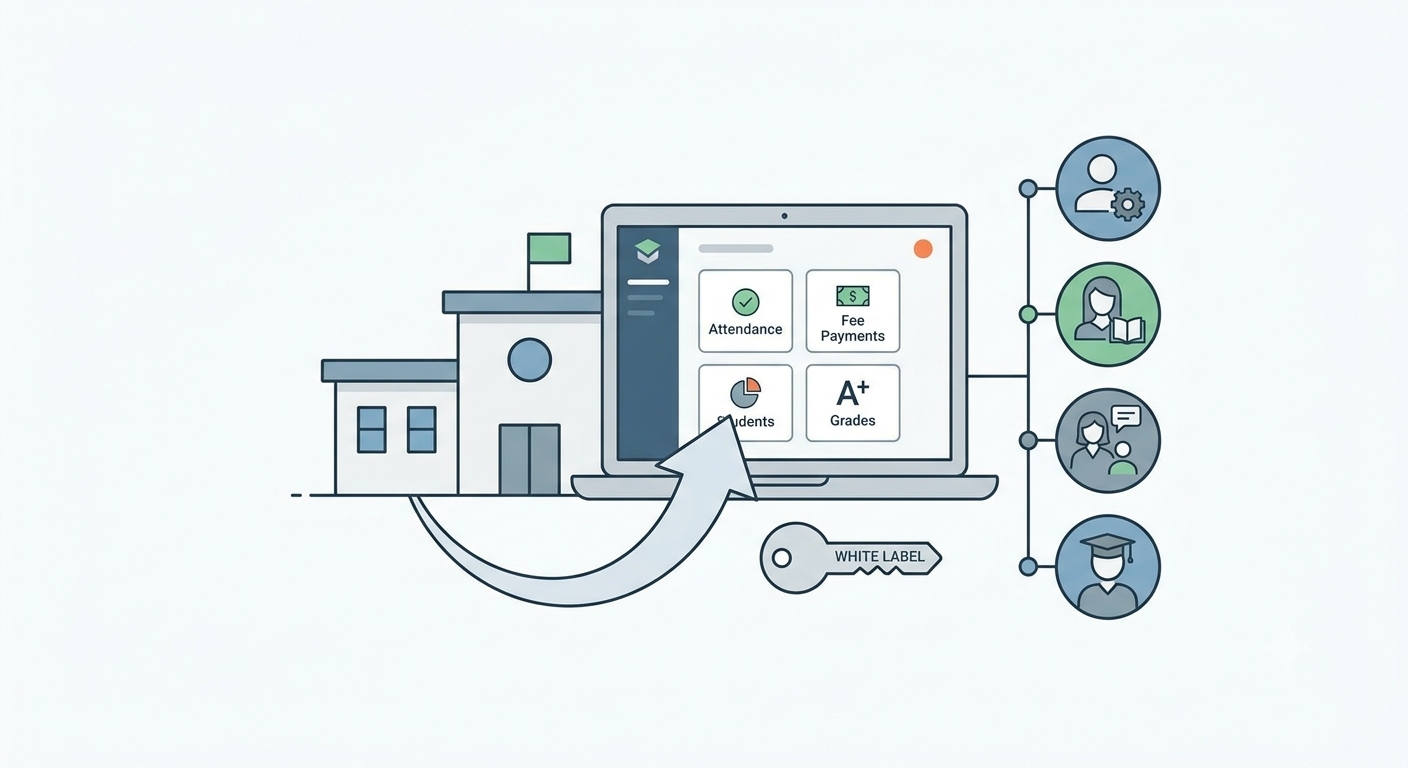
Many of these tasks are combined into a single system by school management software. Depending on the product, schools can manage student records, track attendance, generate fee receipts, organize examinations, and share updates with parents.
For entrepreneurs, the appeal goes beyond selling software once. Schools need reliable systems, ongoing support, staff training, and occasional upgrades. This creates opportunities for long-term customer relationships and recurring revenue.
Smaller private schools can be particularly interesting customers because they may need affordable digital solutions without having the resources to develop or maintain their own technology.
Schools vary, though, in terms of size, funding, and administrative needs. Entrepreneurs who understand these differences have a better chance of offering solutions that customers genuinely value.
There is no single formula for success in educational technology. Some businesses create their own platforms, while others focus on implementation, distribution, and customer support.
The following examples illustrate different business models. They are established industry examples rather than invented personal testimonials or claims about individual reseller earnings.
Byju Raveendran started BYJU'S, which has grown to become one of the most well-known education technology firms in India. Its early growth was built around making learning more accessible through digital lessons and engaging educational content.
BYJU'S's journey exemplifies a crucial entrepreneurial principle: identify an existing problem and develop a digital solution around it, even if the company's primary focus is on learning rather than school administration software.
The lesson for a school software entrepreneur is to start with the needs of parents, kids, instructors, and administrators. A product that simplifies everyday tasks can offer more practical value than one packed with features that schools rarely use.
Teachmint emerged in India with technology designed to help educators and educational institutions manage teaching and school operations. Its offerings have included tools for classroom management, communication, and school administration.
Its broader business story highlights an important opportunity in education technology: schools need more than digital lessons. They also need systems that help staff organize their daily responsibilities.
Entrepreneurs entering this market can learn from this approach by identifying specific administrative challenges. For example, a school struggling with fee tracking may value a reliable payment management system more than an extensive collection of advanced features.
The goal is to solve a problem that customers recognize and are willing to pay to fix.
Fedena is an example of a platform focused on school administration, offering capabilities associated with student information, attendance, fees, examinations, and other institutional processes.
Platforms for school administration show how a solution may meet multiple related demands in a single organization. Instead of using separate spreadsheets and disconnected applications, school staff can work through a more unified system.
For entrepreneurs, this category presents an opportunity to serve schools that want to digitize their operations without assembling several unrelated tools.
The challenge is to find the right customer segment, explain the benefits clearly, and provide dependable support after installation.
You do not necessarily need to become a software developer to enter the education technology market. Several business models allow entrepreneurs to focus on sales, implementation, and customer relationships.
One possible route is becoming a school management software reseller.
Instead of developing an application independently, you partner with a software provider and offer its product to schools. Your responsibilities may include finding prospective customers, demonstrating features, helping schools get started, and providing first-line support.
The exact arrangement depends on the provider. Some companies offer reseller partnerships, while others require separate agreements for branding, customization, pricing, and customer ownership.
Before choosing a provider, check whether it offers suitable licensing terms, training materials, technical assistance, and clear commercial conditions.
This model can reduce the technical burden associated with creating a product from scratch. However, success still depends on understanding school requirements, building trust, and delivering a good customer experience.
Trying to sell to every educational institution at the beginning can make your marketing difficult.
Instead, consider starting with a defined audience, such as small private schools, preschools, coaching institutes, or schools in a particular region.
Each group has different needs. A small school may prioritize fee collection and attendance, while a larger institution may require transport management, staff records, examination reports, and multiple administrative permissions.
It is simpler to prepare pertinent demonstrations, describe the advantages, and create a repeatable sales process when you concentrate on a single segment.
You can expand into other segments after understanding what your first customers need.
Building software independently requires more than writing code. You need product design, testing, hosting, security, maintenance, customer support, and ongoing development.
For a first-time entrepreneur, these responsibilities can make the initial investment difficult to manage.
An alternative is to choose ready to launch school management software that can be customized to suit your target market. With the right product and business plan, entrepreneurs can launch school management software without spending months developing every feature from scratch. This approach allows you to focus on customer acquisition, marketing, implementation, and ongoing support instead of managing the entire software development process yourself.
For example, heloix.com offers ready-made customizable software products that can help entrepreneurs explore launching a software business with a more established starting point, depending on the product's available features and customization options.
Before committing, confirm that the chosen solution actually supports school administration requirements and that you have the necessary rights to sell, brand, or customize it.
A sustainable software business should offer value after the customer signs up.
Depending on your agreement with the software provider, possible revenue sources may include implementation charges, staff training, data migration, technical support, customization, and recurring subscription fees.
For instance, a school might need help transferring existing student records into its new system. Another school may require staff training before it can use the attendance and fee management modules effectively.
These services can distinguish your business from competitors who simply sell access to an application.
Be transparent about pricing, support coverage, renewal terms, and any additional charges. Schools are more likely to maintain a business relationship when they understand exactly what they are paying for.
You do not need an expensive advertising campaign to begin testing this business idea.
Start by speaking with school owners, principals, and administrators. Ask how they currently handle attendance, admissions, fee collection, and parent communication.
Listen before presenting a solution. You may discover that a school already uses software but struggles with training or customer support. Another may rely on spreadsheets because existing products seem too complicated or expensive.
Use these conversations to identify common problems and prepare a demonstration that addresses them directly.
You can also build relationships with education consultants, computer training centers, and local technology service providers who already work with schools.
Your first objective should be to understand the market and secure a few satisfied customers, not to approach hundreds of schools with the same sales pitch.
Before investing heavily, follow a practical approach.
Step 1: Research your market. Speak with at least five to ten schools and identify the administrative problems they want to solve.
Step 2: Compare software providers. Examine features, pricing, customization options, data security, support, and licensing rights.
Step 3: Test the product. Make sure the system works smoothly and is easy for teachers and administrators to use.
Step 4: Prepare a clear offer. Explain what the software does, how implementation works, what it costs, and what support customers receive.
Step 5: Start small. Work with a limited number of schools, gather feedback, and improve your onboarding process before expanding.
Remember that schools handle sensitive student and family information. Data protection, access permissions, backups, and reliable technical support should be part of your evaluation from the beginning.
Also, avoid promising features or results that your software provider cannot deliver.
The school management software market offers opportunities for entrepreneurs who understand education, technology, and customer service. You can develop your own platform, partner with an existing provider, or build a business around implementation and support.
The experiences of education technology companies show that solving genuine problems matters more than simply having a product to sell. For a new entrepreneur, that means listening to schools, choosing suitable software, and building relationships that last beyond the initial transaction.
You do not have to build a complicated technology company overnight. Start with one customer segment, learn what schools need, and develop a business model that can grow as your experience increases.
The real opportunity is not just selling school management software. It is helping schools spend less time on administrative work and more time supporting students.
Please to post a comment
No comments yet
Be the first to share your thoughts.
@heloix_news
EdTech
@heloix_news
EdTech
@heloix_news
EdTech

Subscribe for the latest on technology, business growth and digital transformation.