
HN
@heloix_news
Tech

Robotics Startup Origin Secures $20 Million to Develop Autonomous Construction Machines
#constructionrobots#AI
Kommentieren
3.4K
Mahesh P
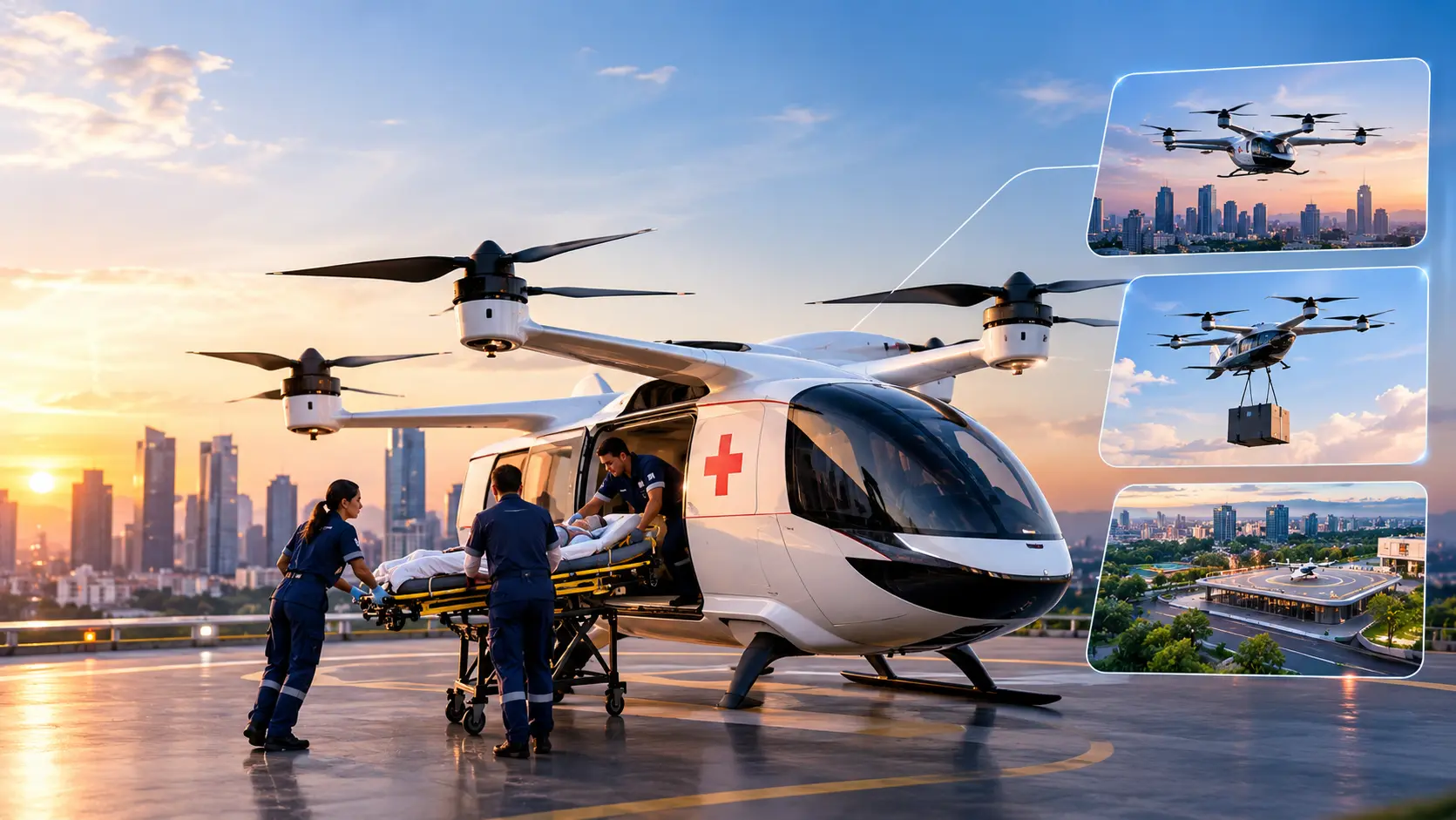
At TechSparks 2026, Professor Satya Chakravarthy, founder and technical lead of The ePlane Company, explained why the startup plans to introduce electric air ambulances before expanding into urban air taxis. Before introducing electric flying cars to regular commuters, the company intends to establish a sustainable business by beginning with a specialized, higher-margin service.
For deeptech startups, developing a breakthrough technology is only half the challenge. Turning that innovation into a viable business is often the harder task.
This challenge was brought to light at TechSparks 2026, YourStory's premier event, by Professor Satya Chakravarthy, an aerospace professor at IIT Madras and founder of The ePlane Company. He described the tendency of technology-focused entrepreneurs to become so absorbed in engineering that they lose sight of whether customers actually need what they are building.
For Chakravarthy, the key question is simple: who is willing to pay for the technology?
The ePlane Company is developing electric vertical take-off and landing aircraft, commonly known as eVTOLs. These battery-powered aircraft can rise and land vertically, much like helicopters, without requiring conventional runways.
However, Chakravarthy believes that technical achievement alone cannot guarantee success. Deeptech companies often spend years developing complex products and require substantial investment before generating meaningful revenue. Without a clear commercial strategy, even impressive engineering can struggle to become a sustainable business.
In the aerospace sector, he argued, startups need to think beyond reaching unicorn status. Their business models must eventually support significantly larger valuations through strong revenue generation and healthy margins.
The idea behind The ePlane Company took shape after Chakravarthy visited Toulouse, France, a major aerospace hub. He was struck by the presence of dozens of smaller aircraft manufacturers alongside established global players.
The experience encouraged him to consider whether India could also develop a world-class aircraft manufacturing business.
With IIT Madras providing an academic and technical foundation, Chakravarthy set out to build an aircraft company capable of competing internationally while operating from India.
The broader ambition is to demonstrate that Indian deeptech ventures can develop sophisticated technologies without losing sight of commercial realities.
Rather than entering the urban air taxi market immediately, The ePlane Company plans to begin with electric air ambulances.
The decision reflects a deliberate approach to managing the economics of a capital-intensive business. Urban air taxis could eventually serve a large number of commuters, but reaching that scale would require substantial aircraft production, operational capacity and customer demand.
Medical transportation offers a different starting point. Emergency healthcare services can support higher-value operations even when the number of aircraft deployed is relatively small.
By prioritising this segment, ePlane hopes to establish an initial revenue base and improve its financial position before expanding production.
The strategy also addresses a practical challenge for new mobility services: matching customer expectations with the number of vehicles available. If a company attracts more demand than its early fleet can handle, customers may become frustrated by limited availability.
Chakravarthy's approach is to start with a clearly defined customer base and expand only as the company becomes capable of serving more people reliably.
For example, a fleet of five electric air ambulances operating in a congested city such as Bengaluru could help improve access to emergency medical transportation without requiring the company to immediately build a large-scale urban aviation network.
Once the business establishes a stable commercial foundation, ePlane intends to explore additional applications, including short-distance air cargo and passenger air taxis.
The long-term proposition for commuters is significant. With certain travels requiring five to eight times less time than road travel, electric aircraft have the potential to decrease some journeys to a fraction of their typical travel time. According to Chakravarthy, these services might eventually cost roughly twice as much as an equivalent Uber journey.
Chakravarthy believes Indian aerospace companies should aim for the same standards of quality and safety as their international counterparts rather than compete primarily on lower prices.
Aircraft operate under the same physical laws regardless of where they are manufactured. As a result, companies must meet demanding safety and certification requirements before their vehicles can enter commercial service.
For ePlane, the challenge is to combine internationally accepted aviation standards with a cost-efficient manufacturing model.
That combination could create opportunities beyond India. Aircraft developed to meet stringent global requirements, while remaining economical to manufacture, could potentially serve international markets as well.
The company has also made specific engineering choices to simplify certification and improve operational reliability.
One example is its decision to avoid a tilt-rotor configuration. Such designs allow propellers to change orientation between vertical take-off and forward flight, but they can introduce additional mechanical complexity. Components that serve multiple critical functions may also create challenges when regulators assess potential failure scenarios.
Instead, ePlane has opted for a multi-rotor architecture supported by redundant systems. The intention is to reduce design complexity and create a more straightforward route towards regulatory approval.
Chakravarthy also argued that concerns about flying vehicles should be considered in the context of existing transportation risks. Commercial aviation is subject to exceptionally demanding safety requirements, and aircraft must demonstrate that they can meet those requirements before receiving approval to operate.
The physical size of an electric aircraft could determine how easily it fits into a city's transportation network.
Building dedicated landing facilities across crowded urban areas would require space, investment and regulatory coordination. To reduce this challenge, ePlane has focused on developing an aircraft with a compact footprint.
The design is intended to make use of existing infrastructure wherever permitted, including hospital helipads and suitable rooftop locations. Potential sites could also include open areas around Metro stations, subject to the necessary safety assessments and approvals.
This approach could help reduce the need for extensive new infrastructure as electric aircraft move towards commercial use.
The company's wider objective is to make flying vehicles practical for real-world urban environments rather than develop technology that works only under ideal conditions.
The ePlane Company's plans also highlight a broader difficulty facing India's deeptech ecosystem: financing businesses that require long development cycles.
Unlike many software startups, aerospace companies cannot necessarily launch a product quickly and improve it through frequent updates. Aircraft development involves extensive engineering, testing, certification and regulatory scrutiny before commercial operations can begin.
Government grants have helped provide support during this process, but attracting private investment for projects with long timelines remains difficult.
Chakravarthy pointed to the shortage of patient capital as a persistent concern. Investors may be interested in ambitious technologies, but they also need to be comfortable with the time and resources required to bring those technologies to market.
For aerospace startups, financial planning must therefore account for the lengthy journey between an initial design and a commercially certified product.
The ePlane Company is targeting commercialisation in 2028, making the coming years important for its plans to move from aircraft development to revenue-generating operations.
Beginning with electric air ambulances gives the company an opportunity to focus on a specialised market before attempting the more demanding task of serving everyday urban commuters at scale.
The strategy also reflects a broader lesson for deeptech founders: solving an engineering problem is not enough. A company must identify customers who need the solution, establish a workable business model and expand at a pace its resources can support.
If ePlane can combine its aerospace capabilities with disciplined commercial planning, it could help demonstrate how Indian deeptech startups can turn complex engineering projects into viable businesses.
The long-term ambition is to make electric flight a practical part of urban transportation. But for now, the company is betting that the first step towards that future may be helping patients reach medical care faster.
Bitte um einen Kommentar zu verfassen
Noch keine Kommentare
Teilen Sie als erste Person Ihre Gedanken.
@heloix_news
Tech
@heloix_news
Tech

@heloix_news
Tech

Abonnieren Sie die neuesten Einblicke zu Technologie, Unternehmenswachstum und digitaler Transformation.