HN
@heloix_news
AI/ML

Comentar
1.2K
Kunchapa Hemanth Kumar
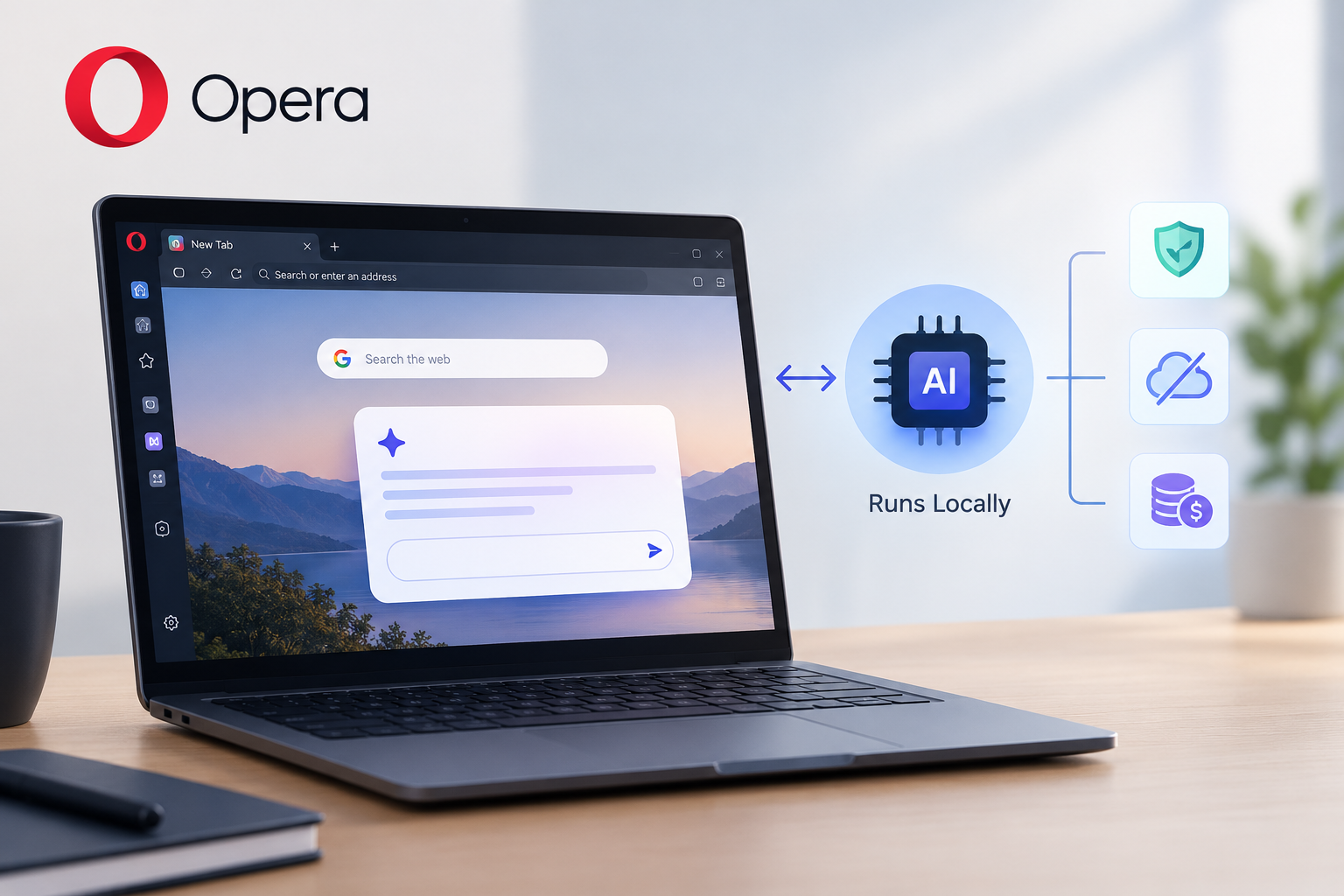
Opera is introducing a new web standard called WebAI that allows users to run artificial intelligence models directly on their computers through their browser, without relying on cloud-based AI services.
Announced on October 27, 2026, the technology aims to make AI tools more private, accessible, and affordable. Instead of sending requests to remote servers, users can process information locally on their own devices.
The feature is currently available as an early preview in Opera One, the company’s flagship browser. Opera plans to bring the technology to its gaming-focused Opera GX browser and its AI-powered Opera Neon browser in the near future.
WebAI is designed to let websites and browser-based applications use AI models that run locally on a user's device. Opera says the standard can work with different AI models rather than being restricted to a single provider.
The company has highlighted Google's Gemma, an open-weight AI model, as one example. On Mac computers, WebAI can also work with Apple's on-device foundation model.
The technology builds on Opera's earlier efforts to bring locally running AI models into its browsers. By developing a more flexible standard, the company hopes to make it easier for developers to introduce AI-powered features without depending entirely on external AI platforms.
One of WebAI's biggest advantages is privacy. With traditional cloud-based AI services, user requests and information may need to be transmitted to a company's servers for processing. Local AI can handle supported tasks directly on the user's computer, reducing the need to send that information elsewhere.
This could be particularly useful when working with personal documents, sensitive text, or other information users prefer to keep on their devices.
Local AI can also help reduce costs. Many AI services charge subscription fees or limit the number of requests users can make. When a compatible model runs locally, users may be able to access certain AI features without paying for a separate cloud service.
Opera says WebAI can support tasks such as text generation, content classification, and identifying relationships between pieces of information.
WebAI is not just intended for individual users. It could also make AI development more accessible by reducing the infrastructure requirements associated with running models online.
Developers who want to add AI features to their websites and applications often need access to cloud computing resources or paid AI APIs. With local models, some of those costs can be avoided because the user's device performs the processing.
The ability to work with different open-weight models also gives developers more flexibility to choose and customize models for their specific needs.
Open-weight models make their trained parameters available for use, although their licenses may still impose restrictions. They should not automatically be considered fully open-source software.
The WebAI announcement is part of Opera's broader effort to integrate artificial intelligence into its browser products.
Opera One is the company's main browser, while Opera GX focuses on gamers and streamers. Opera Neon takes a different approach, using AI agents to help users carry out tasks through the browser.
Introducing WebAI across these products could give users more ways to access AI without depending entirely on cloud-based services.
The feature is opt-in, meaning users must choose to enable it. This gives them control over whether they want to use locally running AI models.
Although local AI can improve privacy, it does not eliminate every security risk. The level of protection depends on the model, the application using it, and how information is handled by the software.
Performance is another important consideration. Running AI models directly on a computer requires processing power and memory, and larger models can place a significant load on a device.
As a result, the speed and quality of the experience will depend on the computer's hardware and the model being used. Devices with limited resources may struggle with more demanding AI tasks.
Users may also find that local models offer different capabilities from larger cloud-based systems.
Opera's WebAI standard could help make on-device artificial intelligence a more common part of everyday browsing. By allowing websites and applications to use local models, the company is offering an alternative to AI tools that rely entirely on remote servers.
The early preview in Opera One is the first step, with support for Opera GX and Opera Neon planned next.
If the approach gains traction among developers, it could lead to more browser-based AI features that cost less to operate and give users greater control over their data.
For now, WebAI represents Opera's attempt to make AI more accessible while addressing two major concerns surrounding the technology: privacy and the cost of running AI services.
Por favor, para publicar um comentário
Nenhum comentário ainda
Seja o primeiro a compartilhar sua opinião.
Inscreva-se para receber as últimas novidades sobre tecnologia, crescimento de negócios e transformação digital.