
HN
@heloix_news
Policy
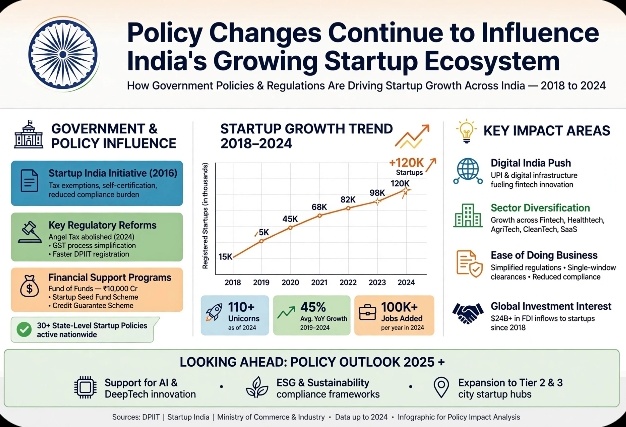
Policy Changes Continue to Influence India’s Growing Startup Ecosystem
#Policy#StartupIndia#Business#Government#Entrepreneurs
Komentar
1.1K
Sumit sanjay
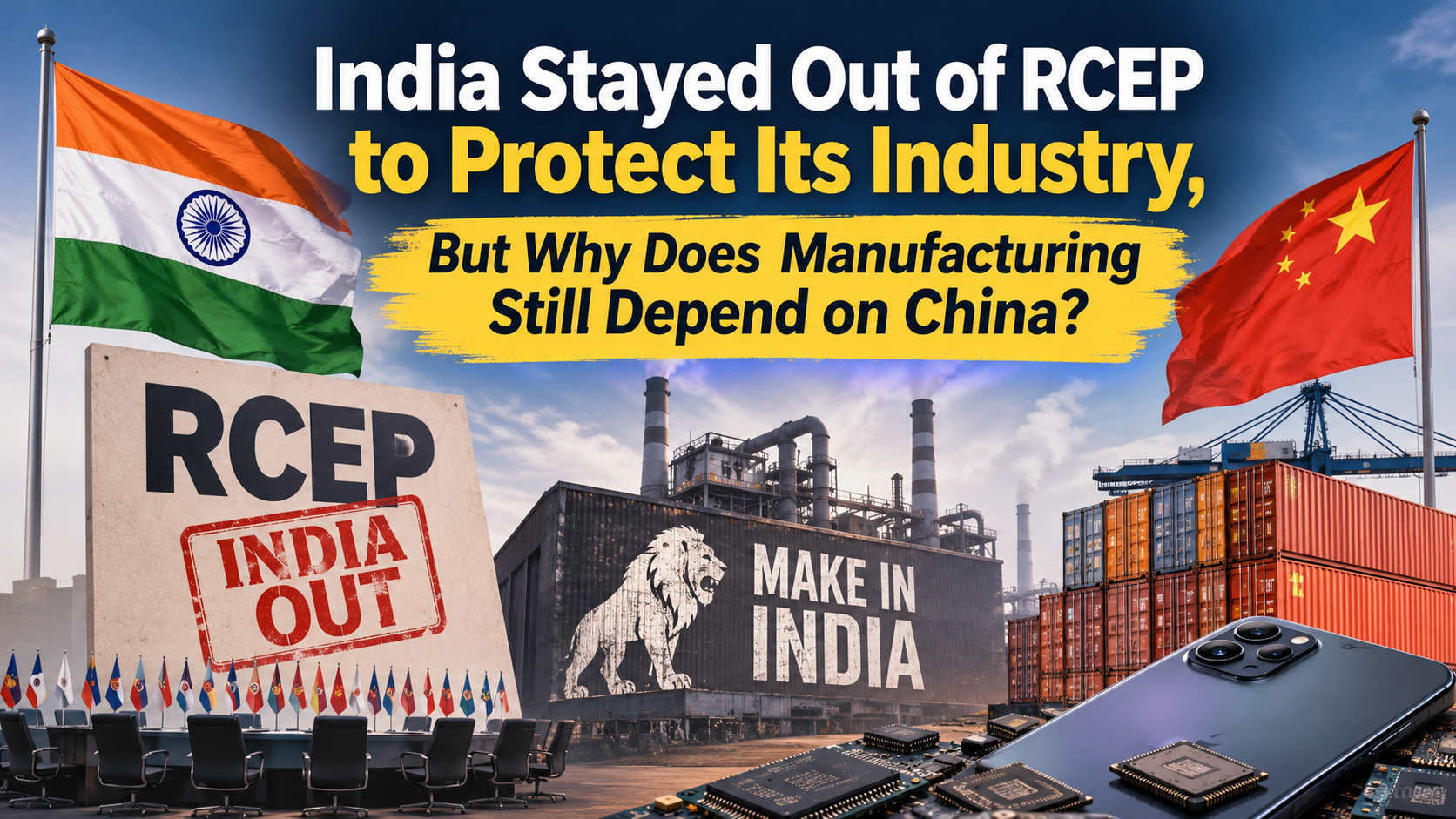
India Stayed Out of RCEP to Protect Manufacturing. So Why Does It Still Depend on China?
India's decision to stay out of the Regional Comprehensive Economic Partnership (RCEP) was largely driven by concerns about protecting domestic industries from foreign competition, particularly from China. However, years after walking away from the trade agreement, India's manufacturing sector continues to rely heavily on Chinese components and raw materials.
Speaking at a conference in Delhi on Thursday, Commerce Minister Piyush Goyal defended India's decision to withdraw from the 15-country trade agreement in November 2019. He argued that joining RCEP would have dealt a serious blow to Indian manufacturing.
According to Goyal, India could have ended up becoming a market for Chinese products rather than building a strong manufacturing base of its own. He suggested that the country might have been reduced to selling and promoting Chinese goods to Indian consumers.
But the reality of India's manufacturing industry raises a different question. Are manufacturing and simply selling imported products really the only two choices available to the country?
Consider the companies that manufacture vehicles in India. Despite producing vehicles domestically, many of them still depend on components sourced from China. Even when an Indian-made alternative is available, it does not always find its way into production.
This raises an important question: Did staying out of RCEP actually help India become more self-reliant, or did the country simply avoid one kind of dependence while continuing to rely on China for essential manufacturing inputs?
### What India Actually Imports From China
Goyal's argument is based on a possible outcome of an agreement India never joined. Whether RCEP would have damaged domestic manufacturing to the extent he suggested is difficult to establish. There is no way to examine that alternative reality with certainty.
However, India's actual trade figures offer a clearer picture of where the country stands today.
According to the Global Trade Research Initiative (GTRI), around half of India's imports from China in 2023–24 consisted of capital goods and machinery. Another 37% comprised intermediate goods, including chemicals, pharmaceutical ingredients and plastics.
The dependence is particularly visible in the electronics sector.
A report published in September found that China accounted for at least 80% of India's imports across 71 electronics product categories in FY26. This represents a significant increase from 44 categories in 2018–19.
Electrical machinery alone contributed $43 billion to India's trade deficit, accounting for approximately 38% of the overall gap. Meanwhile, India's exports of electrical machinery to China stood at just $3.2 billion.
Battery imports tell a similar story. China supplied 83% of India's lithium-ion battery imports in FY26, valued at around $4 billion. This was more than twice the import value recorded in 2021–22.
These figures suggest that India's relationship with Chinese manufacturing goes beyond importing finished products. A substantial part of the dependence comes from the materials, machinery and components that Indian manufacturers need to keep their production lines running.
### Made in India, But Not Entirely Manufactured in India
The smartphone industry offers one of the clearest examples of this contradiction.
According to the Ministry of Electronics and Information Technology, more than 99% of mobile phones used in India are now manufactured domestically. Smartphone exports also reached Rs 2.6 lakh crore in FY26.
On the surface, this looks like a major manufacturing success. India has become an important destination for smartphone production and exports.
However, manufacturing a phone and producing all its components are two very different things.
India still imports a significant share of the parts that go into its smartphones. The domestic value addition, which measures how much of a product's overall value is actually created within the country, remains relatively low.
According to the head of the India Cellular and Electronics Association (ICEA), domestic value addition in smartphones stands at around 18–20%. The IT Secretary has placed the figure slightly higher, at approximately 22–23%.
For comparison, the leading smartphone-producing country achieves domestic value addition of nearly 40%, according to ICEA.
The gap becomes even more apparent when looking at India's broader electronics industry. Components accounted for just 9% of the country's electronics output in 2023–24, Business Standard reported in July.
In other words, India has made considerable progress in assembling smartphones and exporting finished devices, but it still has a long way to go in developing a strong domestic component manufacturing ecosystem.
This also complicates the argument that India would have become a country of salespeople selling Chinese products had it joined RCEP.
India is not simply importing finished smartphones and reselling them. It is assembling devices, manufacturing certain components and exporting finished products. The bigger challenge is that much of the technology and several essential inputs still come from outside the country.
### The Policy Choices Behind India's Manufacturing Gap
India's continued dependence on Chinese components cannot be explained by trade agreements alone. Domestic industrial policies and investment decisions have also played an important role.
A report by Priyal in January highlighted how companies such as Dixon Technologies, Syrma SGS and Amber Enterprises spend less than 1% of their revenue on research and development.
Several partnerships in the sector also involve foreign companies that bring design and technological expertise. These include Dixon's partnership with Longcheer, Syrma SGS's association with Shinhyup, and Bhagwati's collaboration with Huaqin.
Such partnerships can help Indian manufacturers expand production and gain access to established technologies. However, they also highlight the limited investment being made in developing independent research, product design and technological capabilities.
The government's Production Linked Incentive (PLI) scheme for smartphones offers another example.
The scheme provided incentives of 4–6% on incremental sales, encouraging companies to increase production and expand their manufacturing operations in India.
As Anushka reported in 2023, many of the companies benefiting from the scheme were foreign-owned contract manufacturers, including Samsung, Foxconn, Wistron and Pegatron.
The policy helped attract investment, increase production and boost smartphone exports. However, its primary focus was on rewarding incremental sales rather than directly encouraging research, component development or domestic technological innovation.
Essentially, a scheme designed to reward higher sales naturally encourages companies to produce and sell more. It does not necessarily ensure that they will develop the technology and components required to make manufacturing more self-reliant.
### Manufacturing Is About More Than Keeping Imports Out
India's decision to stay outside RCEP may have protected certain domestic industries from greater competition and the possibility of increased imports. However, avoiding a trade agreement does not automatically create a strong manufacturing ecosystem.
The smartphone industry demonstrates this distinction particularly well. India has become a major assembly and export destination, but its dependence on imported components remains substantial.
There is no guarantee that joining RCEP would have solved this problem. In fact, lower import duties on certain components could potentially have increased India's dependence on foreign suppliers. At the same time, it is difficult to establish that staying outside the agreement was the decisive factor behind the country's current manufacturing limitations.
The more important question is whether India's industrial policies are doing enough to encourage domestic research, technological development and component manufacturing.
Protecting domestic industries is only one part of building a manufacturing economy. Countries also need the capacity to design, develop and produce the essential technologies that power their industries.
India may have avoided becoming a marketplace for finished Chinese products, but it cannot claim complete manufacturing independence while so many of its factories continue to depend on Chinese inputs.
The challenge, therefore, is not simply to keep foreign products out. It is to build an industry capable of producing more of what it currently has to import.
Silakan untuk mengirim komentar
Belum ada komentar
Jadilah yang pertama menuliskan pendapat.
@heloix_news
Policy
@heloix_news
Policy

@heloix_news
Policy
Berlangganan untuk info terbaru tentang teknologi, pertumbuhan bisnis, dan transformasi digital.