
HN
@heloix_news
Policy

Yorum Yap
520
Mahesh P
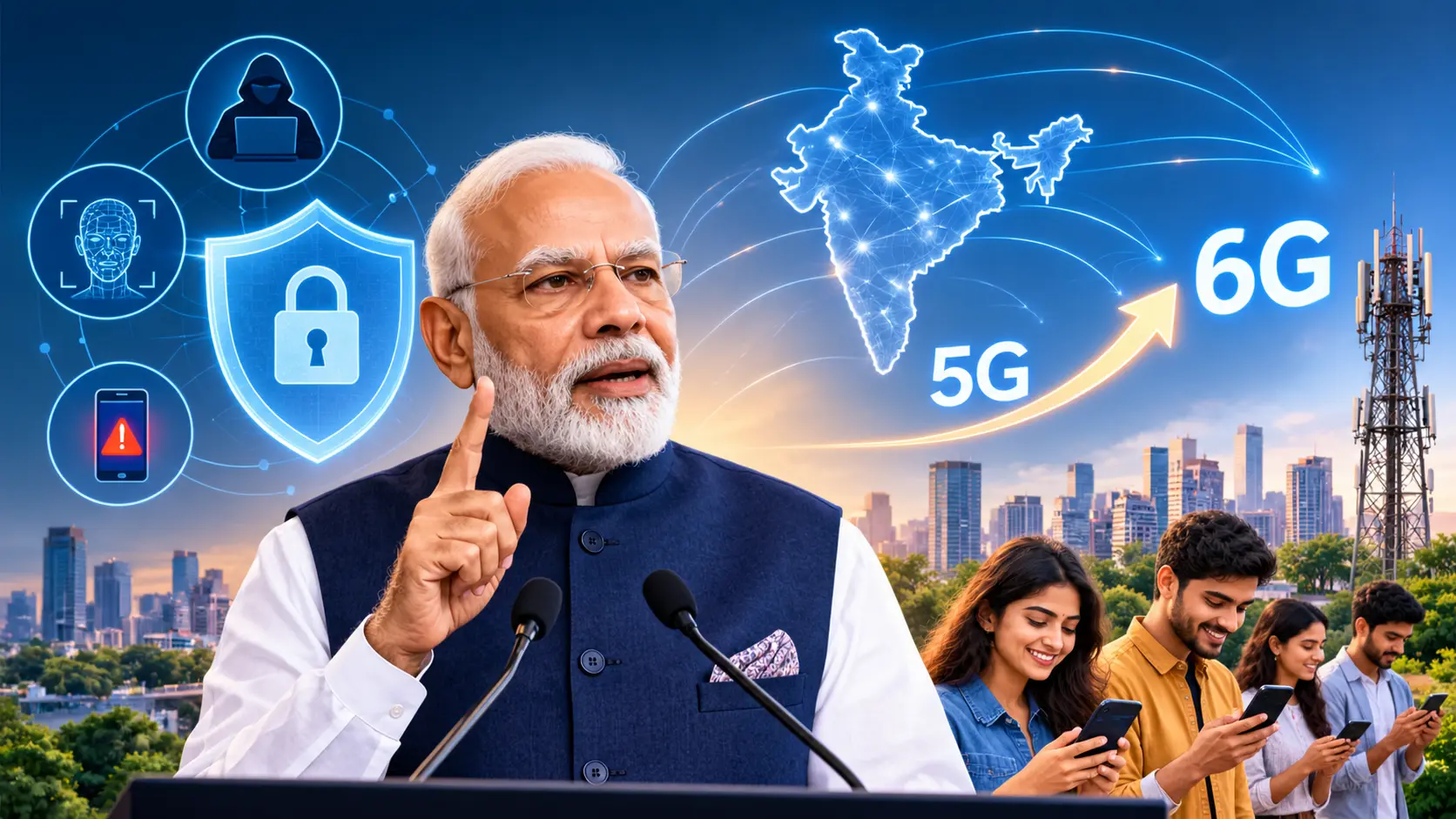
Prime Minister Narendra Modi has called for an international framework to tackle cyber fraud, deepfakes, and other digital crimes, warning that online threats are increasingly crossing national borders. He urged governments, technology companies, telecom operators, and financial institutions to work together to prevent fraud before it reaches potential victims.
Speaking at the inauguration of the 10th edition of the India Mobile Congress (IMC) 2026 in New Delhi on October 8, Modi called on the Global System for Mobile Communications Association (GSMA) and telecom operators worldwide to develop a coordinated mechanism to address these threats.
He also offered to share India's experience in combating digital fraud with other countries, stressing that public trust is essential for the continued growth of technology.
Modi highlighted how criminals can exploit international boundaries to carry out fraudulent activities. Individuals operating in one country may use networks and associates in another to target victims elsewhere, making investigations and enforcement more complicated.
The growing use of deepfake technology has added another layer of risk. Artificial intelligence can generate convincing fake videos, images, and audio recordings that criminals may use to impersonate individuals, spread misleading information, or trick people into transferring money.
Modi said these challenges require a coordinated response involving public authorities and private-sector organisations. A shared global framework could help stakeholders develop more effective ways to identify threats, exchange information, and stop fraudulent activity before it causes financial harm.
The Prime Minister's call comes as cybercrime remains a significant concern in India.
According to data from the Indian Cyber Crime Coordination Centre (I4C), Indians lost approximately Rs 19,813 crore to cyber fraud in 2025, with 21.77 lakh complaints registered during the year.
Investment-related scams accounted for around 77% of the reported financial losses, while digital arrest scams contributed approximately 8%.
Cumulative losses from cyber fraud over six years reached Rs 52,976 crore. The I4C has also projected that annual losses could rise to Rs 1.2 lakh crore.
The international nature of these operations is evident in complaints linked to scam networks operating in Southeast Asia. In 2025, approximately 45% of complaints recorded through the I4C's Citizen Financial Cyber Fraud Reporting and Management System originated from Cambodia, Myanmar, and Laos.
Between 2022 and 2025, 6,998 Indian nationals were rescued from scam compounds in these three countries, according to information provided by the Ministry of External Affairs to Parliament. Many had reportedly been attracted by employment offers before being forced to participate in fraudulent operations.
The Indian government has introduced several initiatives to help citizens identify suspicious communications and reduce the risk of financial fraud.
One of these is Sanchar Saathi, a platform operated by the Department of Telecommunications (DoT). It allows users to report suspected fraudulent calls and messages and access services related to mobile connections and device security.
The government has disconnected more than 4.7 crore mobile connections based on citizen complaints, information from agencies, and the use of artificial intelligence tools to identify SIM cards obtained through fraudulent documents.
Another feature, Chakshu, enables people to report suspected fraudulent communications. Data presented in Parliament in February showed that citizens submitted 5,19,662 reports through the facility in 2025, compared with 2,08,224 in 2024.
The DoT has also introduced a Financial Fraud Risk Indicator (FRI), which assigns risk ratings to mobile numbers suspected of being linked to financial fraud. Banks and financial institutions can use these indicators to assess risk and decide whether additional verification is necessary before processing transactions.
Alongside telecom-based safeguards, the government has taken steps to address harmful content generated using artificial intelligence.
On February 10, 2026, the Ministry of Electronics and Information Technology amended the Information Technology Rules, 2021, introducing requirements for identifying AI-generated content.
Under the revised rules, covered AI-generated material must carry appropriate labels and permanent metadata to help identify its origin. The amendments also require platforms to remove unlawful content within three hours of receiving a government order, compared with the earlier 36-hour period.
These measures are intended to improve transparency and enable faster action against prohibited online content, including material that could be used to mislead people or facilitate digital crimes.
Modi also emphasised that technological progress depends on whether people feel safe using digital services.
For ordinary users, trust is closely linked to everyday activities, such as knowing who is calling them and feeling confident that their money will remain secure when they make online payments.
As smartphones become increasingly important for communication, banking, shopping, and access to public services, protecting users from impersonation and financial fraud has become a key part of digital development.
The Prime Minister's remarks underline the need to combine technological innovation with stronger security measures and greater accountability across the digital ecosystem.
During his address, Modi highlighted India's progress in telecommunications and digital public services.
He noted that 5G services, launched during the India Mobile Congress in 2022, had expanded to every district in the country. India had also established more than 5.5 lakh 5G base stations, while mobile internet speeds had increased tenfold compared with 2022.
The Prime Minister also highlighted the role of Direct Benefit Transfer (DBT) in delivering government assistance directly to beneficiaries. According to him, approximately Rs 50 lakh crore had been transferred to beneficiaries' bank accounts through the system, while around Rs 5 lakh crore had been prevented from going to unintended recipients.
Modi said government initiatives, telecom reforms, and domestic handset manufacturing had helped make mobile phones and internet access more affordable than they were a decade ago.
Lower data costs have also supported the growth of digital entertainment, regional over-the-top (OTT) platforms, and online content creation in smaller towns and rural areas.
Modi also pointed to the role of telecommunications and digital platforms in improving access to education.
He referred to the Digital Infrastructure for Knowledge Sharing (DIKSHA) platform, which recorded more than five billion learning sessions up to July 2022 during the COVID-19 pandemic.
The government also aims to connect approximately 250 million students through its online education platforms, highlighting the importance of reliable connectivity in extending educational resources to learners across India.
These initiatives demonstrate how digital infrastructure can support services beyond communication and entertainment, including education and public welfare.
The Prime Minister's appeal at IMC 2026 reflects the growing recognition that cyber fraud and deepfakes cannot be addressed effectively through isolated national efforts alone.
Criminal networks can operate across jurisdictions, exploit gaps in enforcement, and use rapidly evolving technology to target victims in multiple countries. Tackling these threats requires stronger cooperation between governments, telecom operators, technology platforms, and financial institutions.
For India, the challenge is to build on its domestic digital security initiatives while contributing to international efforts to improve fraud prevention and accountability.
As digital services continue to expand, the success of these efforts will depend not only on technological progress but also on the ability to make online interactions safer and more trustworthy for people around the world.
Yorum yapabilmek için lütfen yapın
Henüz yorum yapılmamış
İlk yorumu siz yapın.
@heloix_news
Policy
@heloix_news
Policy
@heloix_news
Policy
Teknoloji, iş büyütme ve dijital dönüşümle ilgili en güncel gelişmeler için abone olun.